As part of my MBA program we took a cohort trip to Lisbon, Portugal and Berlin, Germany to study each city’s healthcare system in an effort to not only learn more about how they do business, but also to recognize the similarities and differences between our system and each of theirs. While the main point of the trip was the business visits, there was also ample time to explore each city.

Bom dia, Lisboa!
I will openly admit I was not always thrilled with the idea of a 10-day trip with my classmates. As much as I have loved getting to know them, the thought of being in multiple foreign countries for an extended period of time was not exactly how I envisioned traveling Europe. However, much to my surprise, I loved traveling with them. Sure, there were moments of embarrassment (can we just ditch the selfie-stick already?) and frustration as is to be expected with large group travel, but these moments are greatly over-powered by the good company, good conversation, and phenomenal business visits.
Our trip started in Lisbon and was my first visit to Portugal. One of the observations that stood out the most for me, particularly when contrasted with our visits in Germany, was how welcoming all of the people were we encountered during our business visits. It seemed to me they wondered why Portugal, but ultimately, were both happy and honored to have us in their country and excited to share with us how they administer healthcare. Having done my pre-trip homework I understood Portugal to have a National Health Service (NHS), which is not entirely free I learned (though I am not completely straight on when it is and when it is not) and in speaking with a member of Portugal’s Parliament, he stated most of Portugal’s population is pleased with the care rendered at the public hospitals. Knowing this, my expectations of the public hospital were high, so I was surprised by what I saw when visiting a public hospital in Lisbon. To be fair, it is, if I remember correctly, one of the oldest and largest public hospitals and it has not yet undergone renovations. However, I realized how accustomed I have become to the large, newly renovated hospitals I have been exposed to in Chicago. Were I to move to Lisbon, I would strongly consider private health insurance and I think that is because of what I know a hospital can be. I don’t know that I would feel the same had I grown up in Lisbon and only known the public hospital system. I think that is the reason why the Portuguese are satisfied with the NHS, it is what they know and they are happy with the care they receive.
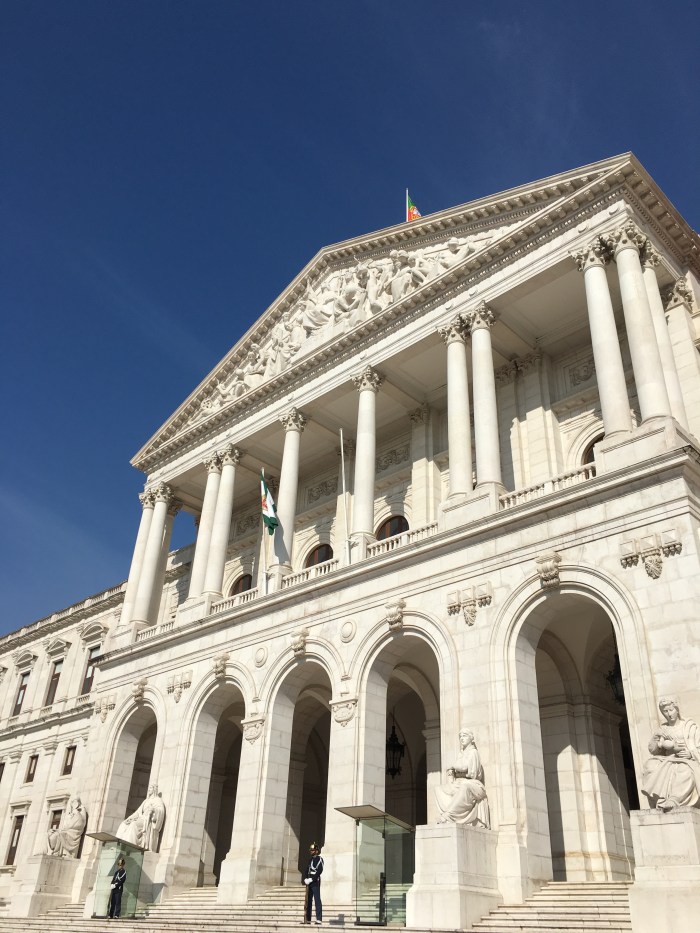
Parliament
In both Lisbon and Berlin I was very quickly reminded of how much I appreciate the fact that one can no longer smoke in restaurants. During our first dinner in Lisbon I initially wondered why I was feeling stuffy and came to realize it was just from the smoke coming from the table next to ours. At the risk of sounding very American, I am happy this is something I no longer have to deal with in the United States. Having lost a loved one to the negative effects of smoking, I am sensitive to it and prefer to stay as far away from it as possible and, though I know it is still a major problem in the United States, smoking is also still rampant in Europe.
Arriving in Berlin I also felt a shift in attitude. It is true what they say about Germans – they are timely and to the point. This is not to say they are unfriendly, I think they just place a high value on time. This was true not only during our business visits, but also during our cultural events.
I found the first day of business visits the most interesting (and prepare yourself while I geek out over healthcare, healthcare IT, specifically). I still find it hard to believe the German Hospital Federation (GHF) requires hospitals to report on 400 quality measures. Beyond that, because only a few hospitals are using an electronic medical record, hospitals report on these measures manually. There is no way that would happen in the United States. It is already hard enough to get providers to document 13 quality measures in a system that allows for data to be extracted systematically. I also found it interesting that the Nursing Director at the trauma center was not clear on what those measures were. It seemed to me there was a disconnect between what we learned at the GHF and what was actually happening in practice. In the United States you would be hard-pressed to find someone in the healthcare field who was not familiar with the Meaningful Use program and its requirements. I am looking forward to keeping a pulse on what next steps the European Union takes around requiring EMR implementation and interoperability. While I was working at Epic, I worked on an RFP for a French hospital interested in purchasing Epic. However, there was a unique rule in French law that required the implementing company to foot any loss incurred during the go-live so, as you can imagine, we did not move forward with the project.
Another observation from the trauma center was the fact that they implemented a system without a back-up server or a means by which to retrieve data should something happen. Again, it seems Europe is much more lackadaisical when it comes to protecting patients’ information and records. I wonder, too, if this will change should the EU move forward with requirements around EMR implementations.
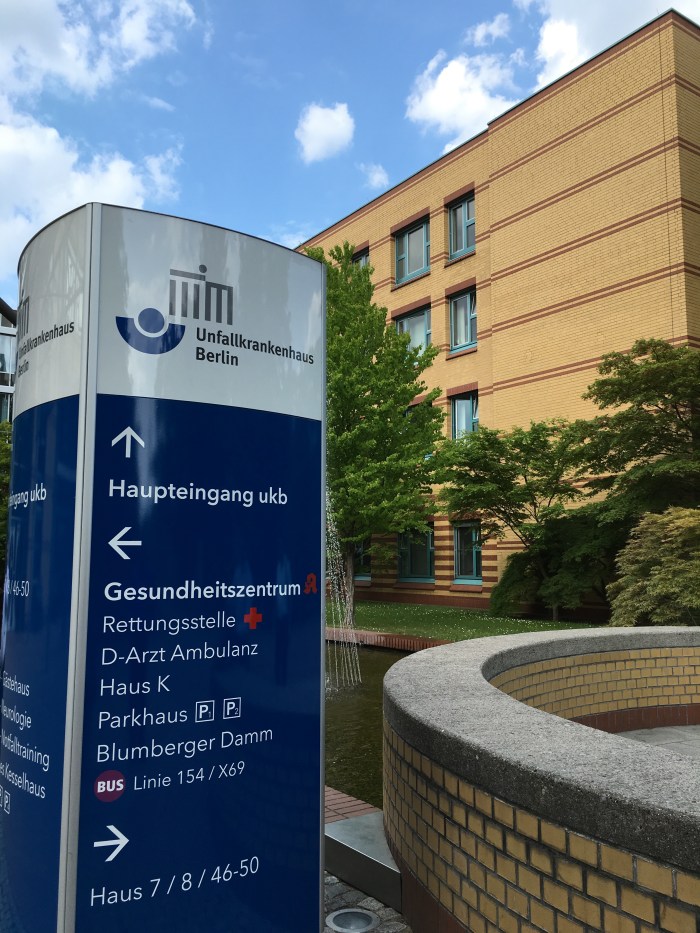
Finally, the observation that has really stuck with me is what we learned when touring the triage area in the trauma center. It is very telling when a German nurse associates gunshot victims with Chicago. I believe he said they see an average of 20 gunshot victims a year. Chicago say 69 gunshot victims, 6 of which were fatal, over the Memorial Day weekend alone. I find myself frustrated because I don’t really know what I can do to make a difference, but I know it has made me more passionate about sharing my views on gun control and having the sometimes uncomfortable conversations.

Berlin Evening Sky
 pink peonies, please